


What We Do: Tournament Context

The US Open is here! Every day during Grand Slams, we at Dweck Sports distribute resources to help you be better prepared for the following day’s action and watch the most exciting and dramatic matches as they are happening.
For 2026’s final Slam, we are reintroducing everything in one fell swoop. Three articles, all up now, with everything you need to know for us to help you have your most intense, exciting tennis viewing experience yet. And maybe show off a little bit of your newfound ball knowledge in the process. This article is about our Tournament Context
The Simulator
If we can use our model to predict one match, then we can use it to predict any matchup in an entire draw. And if we combine those predictions, we can simulate through a tournament. We do it 25,000 times every day from the day qualifiers are placed in the main draw until the day before the semifinals to get a complete picture of the tournament at every stage. There are a lot of second-, third-, and fourth-order effects of every result that are not immediately easy to see, but the simulator sees all. Here is an example of what I am talking about from Wimbledon. From these simulators, we produce matchup probabilities, tournament outlooks, and rooting guides for each player (not every player actually gets a rooting guide – more on that in the bottom section).

And in this year’s US Open women’s draw, the #1 ranking is up for grabs! We have the rankings and the scenarios loaded in, so we will be giving you an update every day on those probabilities for the four contenders: Elena Rybakina, Aryna Sabalenka, Jessica Pegula, and Coco Gauff.
Matchup Probabilities
The simulator works by picking a match, moving the winners up through the draw, and then picking the next one. So, we can predict the probability of any possible matchup throughout the tournament. Follow us on social media for a video coming up with our top 10 most likely US Open finals!
Tournament Outlook

Our tournament outlooks combine the previous two sections: the probability of reaching a certain round and the matchup probabilities. This graphic provides a quick look at what each round would look like for a certain player. The top box has the probability of reaching that round, and underneath it, the green bars show the probability of facing each opponent in that round given that they make it there.
Rooting Guides
In the end, after all the matchups are made, every point is played, and a champion is crowned, the two finalists will have combined to play less than one ninth of the tournament. But, as we can see from everything else that the simulator produces, the 114 main draw matches that include neither finalist (to make no mention of the 112 qualifying matches that already happened, of which no one played more than 3) are hugely important in determining who the two are who have the honor of playing that seventh match two weeks from now. In other words, if you are a fan of a top player, most of your tournament will still be about scoreboard watching.
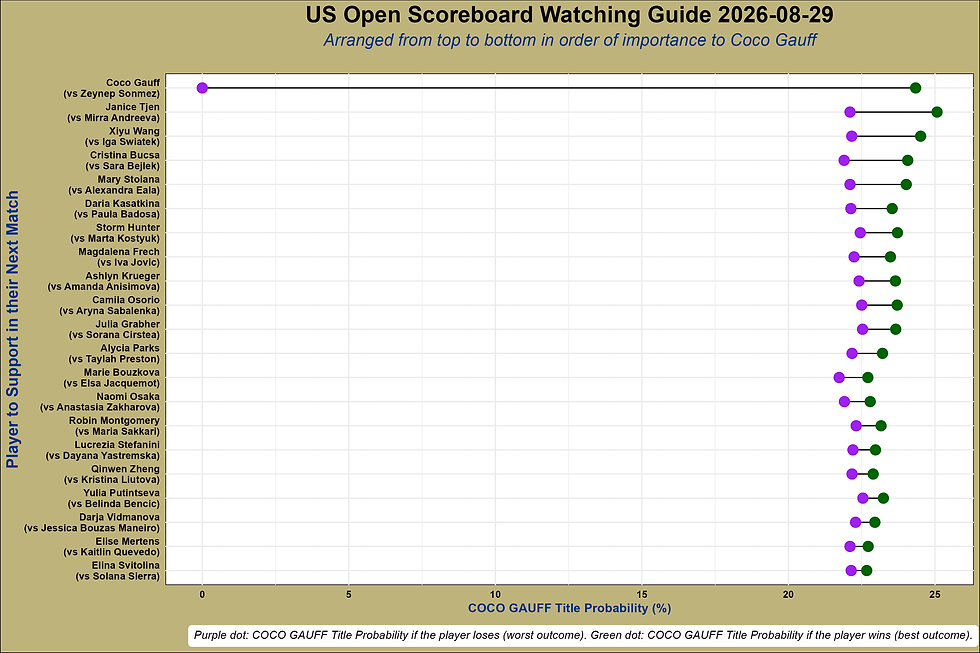
For players in with enough of a chance to win the title for sample sizes to work properly, we will produce a graphic that looks like this. It answers the question “which players does my favorite player want to see win their next match to maximize their chances of winning the US Open?” They are arranged from top to bottom from most to least important


Comments